

Smart Farming 2025: How Technology Is Transforming the Future of Indian Agriculture
- riddhishimportexpo
- Dec 8, 2025
- 3 min read

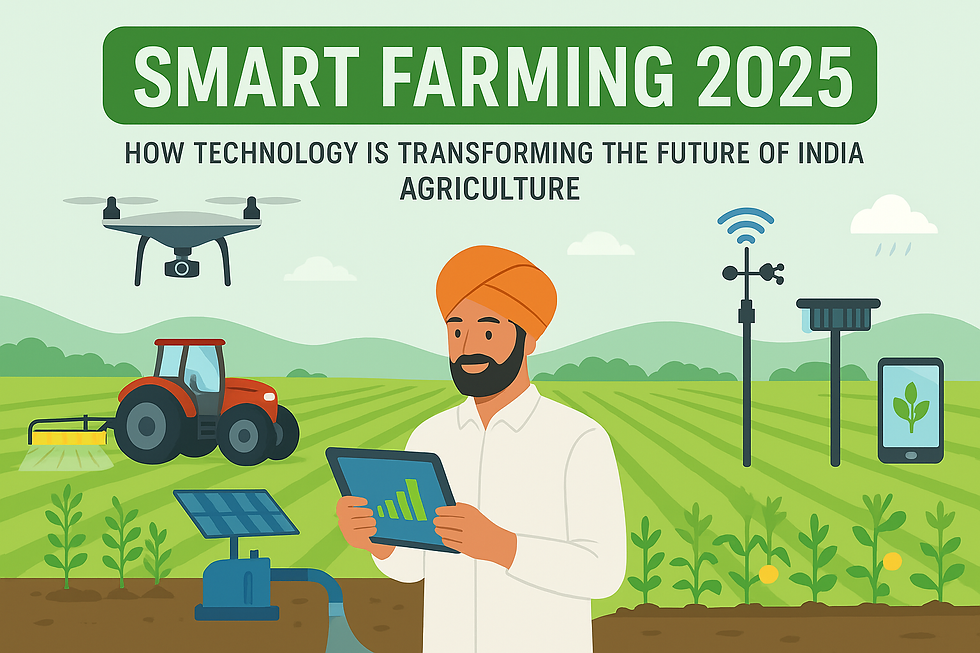
Modern farming is changing faster than ever. With rising labor shortages, unpredictable weather, and increasing demand for higher yields, farmers are turning to technology-driven solutions that make agriculture more efficient, sustainable, and profitable. This new era—often called Smart Farming—combines machines, data, automation, and innovation to help farmers produce more with less effort.
Below is a detailed look at how smart technology is reshaping the future of Indian agriculture.
1. What Is Smart Farming?
Smart farming uses modern tools like sensors, drones, mobile apps, automated machines, and AI-based guidance to monitor, manage, and improve farming activities.It helps farmers make better decisions based on real-time data, not guesswork.
Examples include:
Soil sensors that measure moisture and nutrients
Drones that scan crop health
GPS sprayers that spray crops evenly
Battery-operated equipment that saves time and energy
Smartphone apps for farm management
2. Key Smart Technologies Used by Modern Farmers
a) Drone-Based Crop Monitoring
Drones have become extremely popular among progressive farmers. They help map fields, detect diseases early, and reduce crop loss.
Advantages:
Quick scanning of large fields
Identifies nutrient deficiencies
Helps plan fertilizer and pesticide use
Saves time compared to manual checking
b) Advanced Spraying Equipment
Sprayers are becoming smarter, more comfortable, and more efficient.Modern farmers use:
Battery-operated sprayers
Knapsack sprayers
Trigger-controlled nozzles
High-pressure pumps
These ensure uniform spray coverage and reduce chemical wastage—leading to healthier crops and lower costs.
c) IoT-Enabled Soil & Weather Sensors
Farm sensors automatically track:
Soil moisture
Temperature
Humidity
Rainfall
Soil nutrients
Farmers receive alerts on their phone, helping them decide when to irrigate or fertilize.
d) Solar-Powered Farm Tools
Solar energy is becoming a game-changer for Indian farms. Solar pumps and solar sprayers reduce electricity bills and solve the problem of unreliable power supply.
Benefits:
Zero electricity cost
Environment-friendly
Works in remote areas
e) Mobile Apps & AI-Based Advisory
Apps now provide instant suggestions on:
Best fertilizer schedule
Pest identification
Market prices
Weather predictions
Government schemes
Farmers can make smarter decisions quickly, without depending on middlemen.
3. How Smart Farming Saves Money & Increases Yield
Smart tools are not just modern—they are profitable.Here’s how they help:
1. Reduced Chemical Wastage
Accurate sprayers ensure chemicals are applied correctly, saving money and improving plant health.
2. Lower Labor Requirement
Battery-operated equipment and automated tools reduce manual effort, solving labor shortage problems.
3. Better Crop Monitoring
Early detection of diseases prevents large-scale damage.
4. Higher Productivity
Healthy crops + reduced input cost = increased yield and profit.
4. Challenges Farmers Face—and How Smart Tools Solve Them
Traditional Problem | Smart Farming Solution |
Labor shortage | Battery & automated machines |
Water scarcity | Smart irrigation, soil sensors |
Unpredictable weather | Accurate weather apps, sensors |
Rising input cost | Precise chemical application |
Crop diseases | Drones & mobile diagnosis |
5. The Future of Farming in India
By 2030, most Indian farms will use:
Autonomous tractors
Smart sprayers
Weather-prediction AI
Fully monitored farms
Automated irrigation
Solar-powered machines
Farmers who adopt technology early will lead the next agricultural revolution.
Conclusion
Smart farming is more than a trend—it is the future of agriculture.By adopting modern tools such as drones, sensors, battery sprayers, and AI apps, farmers can increase productivity, reduce costs, and improve crop health. The future belongs to farmers who combine traditional knowledge with modern innovation.


Comments